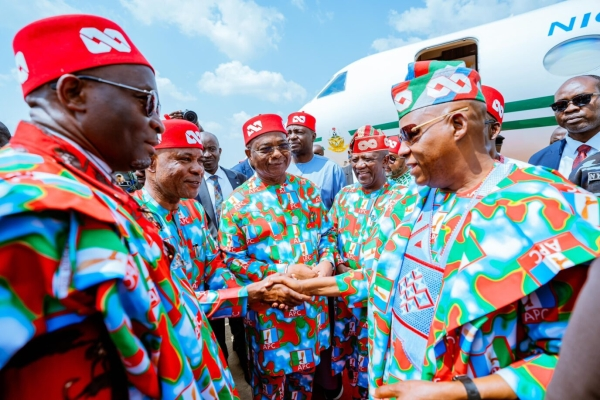
Vice-President Kashim Shettima has stirred fresh debate over Nigeria’s 2031 presidential succession after assuring the South-East that the region could produce the country’s president when power eventually returns to the South.
Shettima gave the assurance on Thursday at the All Progressives Congress (APC) presidential campaign rally in Awka, Anambra State, where he appealed to the Igbo to strengthen political alliances, embrace national unity and build stronger relationships with other regions.
“In the next dispensation when power comes to the South, I can assure you that power will find its residence in the eastern region,” the Vice-President declared.
His remarks appear to offer a significant political signal to the South-East, which has continued to seek greater representation at the highest level of Nigeria’s political leadership.
Shettima also described President Bola Tinubu as a friend of the Igbo, arguing that the President’s family connections to the region demonstrate his administration’s goodwill towards Ndigbo.
“President Tinubu is a friend of Ndigbo. His son, Seyi, is married to a lady of Igbo extraction. If he hates Igbo, he couldn’t have allowed his son to marry an Igbo lady. So we are essentially one people,” he said.
The Vice-President further highlighted the Igbo population and their economic influence across Nigeria, claiming that approximately 17 million Igbo people live in northern Nigeria, while another 10 million reside in Lagos.
He warned against allowing ethnic sentiments and political disagreements to weaken relationships between the South-East and other parts of the country, urging the region to pursue broader political partnerships.
Citing former President Muhammadu Buhari’s electoral experience, Shettima argued that winning Nigeria’s presidency requires political alliances beyond a candidate’s traditional support base.
He recalled that Buhari lost the presidential elections in 2003, 2007 and 2011 despite commanding a substantial northern voting bloc.
“Peter Obi cannot be more popular than Muhammadu Buhari,” Shettima said, before explaining that Buhari eventually secured victory in 2015 through political alliances across the country.
“It was by having a handshake across the Niger that he was able to win the presidential election in 2015,” he added.
Shettima maintained that political cooperation across ethnic and regional boundaries remained essential to securing electoral victories and advancing national development.
He also disclosed that some of his closest political associates and personal friends were from the South-East, insisting that relationships across regional boundaries were stronger than political and ethnic differences.
“That shows that what binds us together supersedes whatever that divides us. We are eager to come along with Ndigbo,” he said.
POWER ROTATION AND THE 2031 PRESIDENCY
Shettima’s assurance comes amid growing political calculations over Nigeria’s informal power rotation arrangement between the North and South.
The North occupied the presidency under Muhammadu Buhari between 2015 and 2023, before power shifted to the South following Tinubu’s emergence in 2023.
Tinubu’s first term ends in May 2027. If re-elected, his second term would run until 2031, completing eight years of southern leadership.
Under the traditional zoning arrangement, the North could then seek another eight-year presidential tenure, potentially pushing the next opportunity for the South to 2039.
Such a scenario could create another opening for the South-East to pursue its long-standing ambition of producing Nigeria’s president.
However, Nigeria’s Constitution does not provide for presidential power rotation or guarantee the presidency to any geopolitical zone. Future zoning arrangements will depend on political party decisions, negotiations and the balance of power among regional stakeholders.