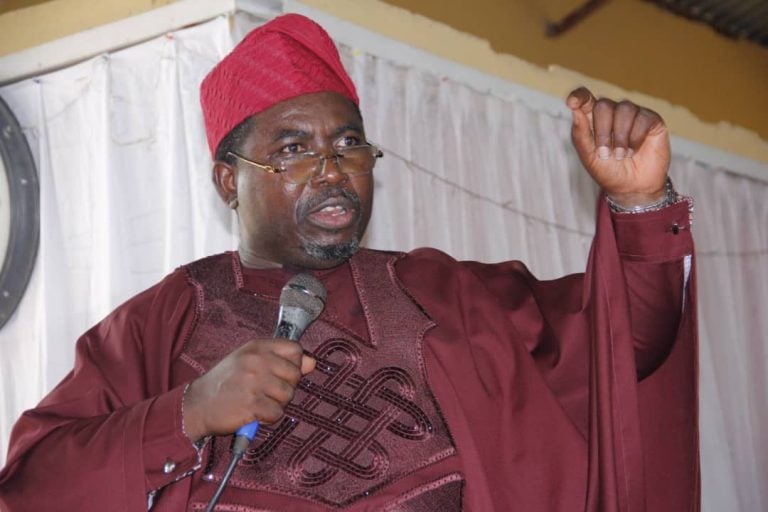
The ruling All Progressives Congress (APC) has unveiled an ambitious four-pillar manifesto outlining President Bola Tinubu’s proposed second-term agenda, with commitments covering insecurity, food affordability, job creation, infrastructure, healthcare, housing and economic growth between 2027 and 2031.
The manifesto, titled Renewed Hope Agenda 2.0, was made available to PUNCH Online on Tuesday and outlines more than 35 major commitments the party says it intends to pursue if Tinubu secures re-election in 2027.
The document reorganises the administration’s existing eight-point agenda into four strategic pillars, providing a roadmap for the party’s proposed governance priorities over the next four years.
The four pillars are Secure and Resilient Nation; Better Quality and More Affordable Life for Every Nigerian; Energy, Infrastructure and Economic Growth; and Effective and Accountable Governance.
1. Security: APC promises stronger military, 50,000 additional police officers
Under its security agenda, the APC promises to strengthen Nigeria’s military capabilities, expand intelligence-led counterterrorism operations and intensify efforts against banditry, kidnapping and insurgency.
The party pledges to complete and equip four new Army divisions in Makurdi, Ilorin, Jalingo and Benin City, recruit and train 28,000 additional military personnel, and establish specialised zonal counterterrorism capabilities.
It also promises to deploy 50,000 newly recruited police officers, expand police recruitment towards a ratio of one officer to 400 citizens, and introduce modern policing technology, including body cameras, digital crime records, forensic infrastructure and emergency response systems.
The manifesto further proposes accountable state and community policing through constitutional and legislative reforms.
2. Cost of living: APC targets affordable food, healthcare and housing
Addressing the rising cost of living, the ruling party promises measures aimed at improving household purchasing power, expanding social protection and making essential services more affordable.
On food security, the APC pledges to strengthen strategic grain reserves, stabilise staple food supplies, reduce transportation costs and introduce a monthly food-price tracking system.
The party also promises to expand healthcare insurance coverage to 40 per cent of Nigerians by 2031, reduce out-of-pocket healthcare spending from 71 per cent to below 50 per cent, and increase functional primary healthcare centres from 53 per cent to 90 per cent.
In housing, the manifesto proposes the construction of 200 homes in each of Nigeria’s 774 local government areas, amounting to 154,800 units, alongside a broader target of delivering 200,000 homes through government-backed and private-sector initiatives.
It also promises affordable mortgages, digital land titles and expanded housing finance.
3. Education and employment: 2 million youths targeted for skills training
The APC says it will intensify efforts to reduce unemployment, improve educational access and equip young Nigerians with employable skills.
The manifesto proposes training two million young Nigerians, expanding digital literacy programmes towards 30 million beneficiaries and strengthening access to entrepreneurship funding.
It also promises to recruit and train 20,000 additional teachers, expand school-retention programmes and strengthen science, technology, engineering, mathematics and digital education.
The party further targets halving youth unemployment by 2031 through expanded skills development, private-sector partnerships, entrepreneurship financing and employment programmes.
4. Women’s empowerment: APC promises 35% representation in government
On women’s inclusion, the party promises to work towards at least 35 per cent female representation in the next federal Cabinet and major ministries, departments and agencies.
It also plans to expand access to affordable business financing, strengthen the Nigeria for Women Project across all 36 states and establish more comprehensive support systems for survivors of sexual and gender-based violence.
5. Infrastructure and economy: Focus on electricity, roads, railways and exports
Under its economic growth agenda, the APC promises to address Nigeria’s electricity challenges, expand industrial power supply and strengthen gas-to-power projects.
The manifesto also prioritises the completion of strategic road and railway corridors, modernisation of seaports and airports, expansion of broadband infrastructure and improved connectivity between agricultural and industrial centres.
On industrialisation, the party says it will promote non-oil exports, strengthen local manufacturing, develop industrial clusters across the six geopolitical zones and attract long-term investment into strategic sectors.
It also targets more than doubling Nigeria’s non-oil export earnings through manufacturing, agro-processing, pharmaceuticals, digital services and other export-oriented industries.
6. Governance: APC promises judicial reforms, transparency and local government autonomy
The fourth pillar focuses on strengthening public institutions, improving accountability and making government services more accessible.
The APC promises nationwide digitalisation of court processes by 2029, improved judicial efficiency, stronger anti-corruption institutions and faster resolution of legal disputes.
It also pledges to strengthen local government financial autonomy, complete outstanding government restructuring reforms and introduce digital public-service delivery systems.
The party further promises quarterly engagements with citizens, public performance dashboards and measurable targets for government officials.
First 100 days: APC outlines four immediate priorities
The manifesto identifies four major priorities the party says will guide the first 100 days of a proposed second term.
These include:
-
Publishing measurable baselines and assigning specific officials to oversee key commitments under the four pillars.
-
Introducing a quarterly cost-of-living basket to monitor changes in household expenses.
-
Identifying and opening secured farm-to-market corridors, with publicly available security and agricultural output data.
-
Launching a Citizen Service Guarantee and a government-wide 'tell government once' policy to simplify access to public services.
How APC says it will fund and monitor its promises
The party says its proposed development agenda will rely on recovering lost public revenue, reducing waste, completing abandoned projects and improving the efficiency of government spending rather than depending excessively on additional taxes and borrowing.
It also promises to attach a specific budget, responsible official, implementation timeline and measurable target to every major commitment.
According to the manifesto, progress will be monitored through publicly accessible performance dashboards and independent verification, allowing Nigerians to track implementation.
The unveiling of Renewed Hope Agenda 2.0 places security, economic recovery, infrastructure development and social welfare at the centre of the APC's proposed 2027–2031 second-term programme, should Tinubu win re-election.